
How do I create a Build Your Own Bundle offer?
Build Your Own Bundle hands the choosing to the customer. You define the steps and the reward; they pick what goes in.
Build Your Own Bundle hands the choosing to the customer. You define the steps and the reward; they pick what goes in.
It converts because the customer builds something they actually want, rather than accepting a set you guessed at. It also lifts basket size naturally — the reward grows as they add, so the incentive to keep going is built into the interaction.
BYOB works differently from every other bundle type. It has no product eligibility, country, active dates or countdown, because it isn’t attached to a product page at all. It lives on its own Bundle Listing Page, and that page’s address is the bundle’s identity.
Before you start — Sledge must be active on your theme. Decide what the offer is and what it costs you before you build it. The example throughout this guide is BYOB Accesories, built from category steps — Bag, Sneakers, Glasses, Caps & Hats and Belts.
Step 1 — Name it and choose where it applies
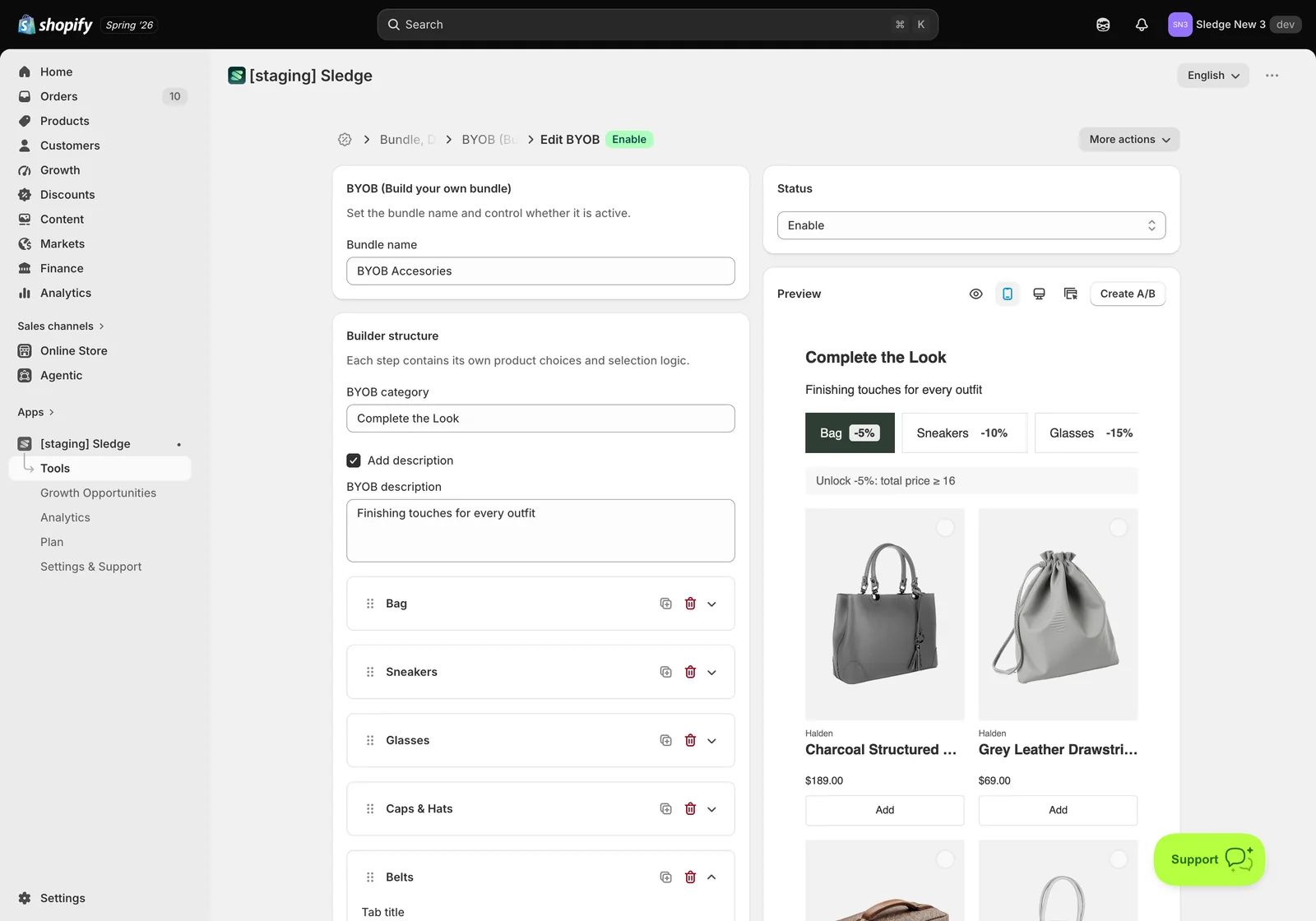
- Go to Tools → Bundle, Discount & Upsell → BYOB and open the bundle you want to edit, or create a new one.
- Bundle name — customer-facing, so write it as a shopper would read it.
- BYOB has no product eligibility. Instead of attaching to product pages, it lives on its own listing page — you’ll set that address under Surfaces in the next step.
Step 2 — Build the offer
The Builder structure section is where this bundle type does its real work.
Builder structure is the heart of this type. Each step is a category the customer picks from:
- Steps — add one per category (Bag, Sneakers, Glasses, and so on) and choose which products belong in each.
- Minimum and maximum products — how many items make a valid bundle. The minimum is at least two.
- Discount — the reward. Set it globally, or per step so different categories carry different savings.
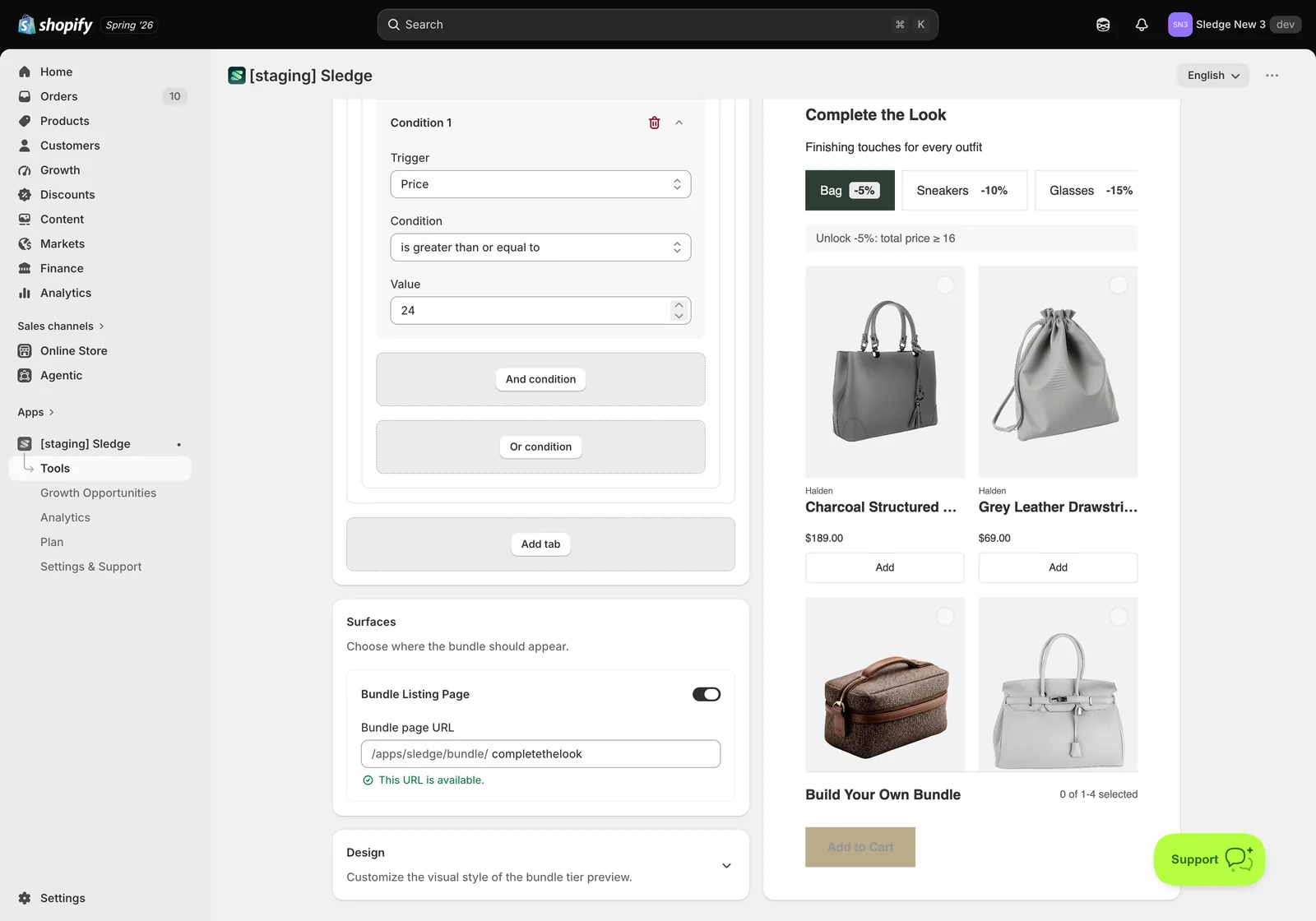
- Conditions — extra rules that must be met before the discount unlocks.
Under Surfaces you set the Bundle Listing Page address. This is the one blocking field on the page — the bundle needs a unique URL to live at, and Sledge checks it as you type.
Under Surfaces, switch on where the offer should render. BYOB uses the Bundle Listing Page.
Step 3 — Customise how it looks
The Design card is what makes the offer look like part of your theme rather than an app bolted onto it. It’s optional, and it’s the difference between an offer customers trust and one they scroll past.
- Bundle label, price and compare-at price colours — the text customers read first.
- Badge (and, on tiered types, medal) colours — the flag carrying your savings message. Give it contrast; it does the selling.
- Card background, border, border radius and padding — the panel itself. Radius and padding are what match it to your theme’s other cards.
- Featured card — a separate colour used only where the bundle appears as a card in a product grid on Collection, Search and Instant Search.
Watch the Preview as you edit — it re-renders live, so you can judge the real thing instead of guessing from hex codes.
Step 4 — Save and publish
- Check the Preview, then click Save.
- Set Status to Enable. A saved bundle that is still disabled won’t appear for anyone.
Result
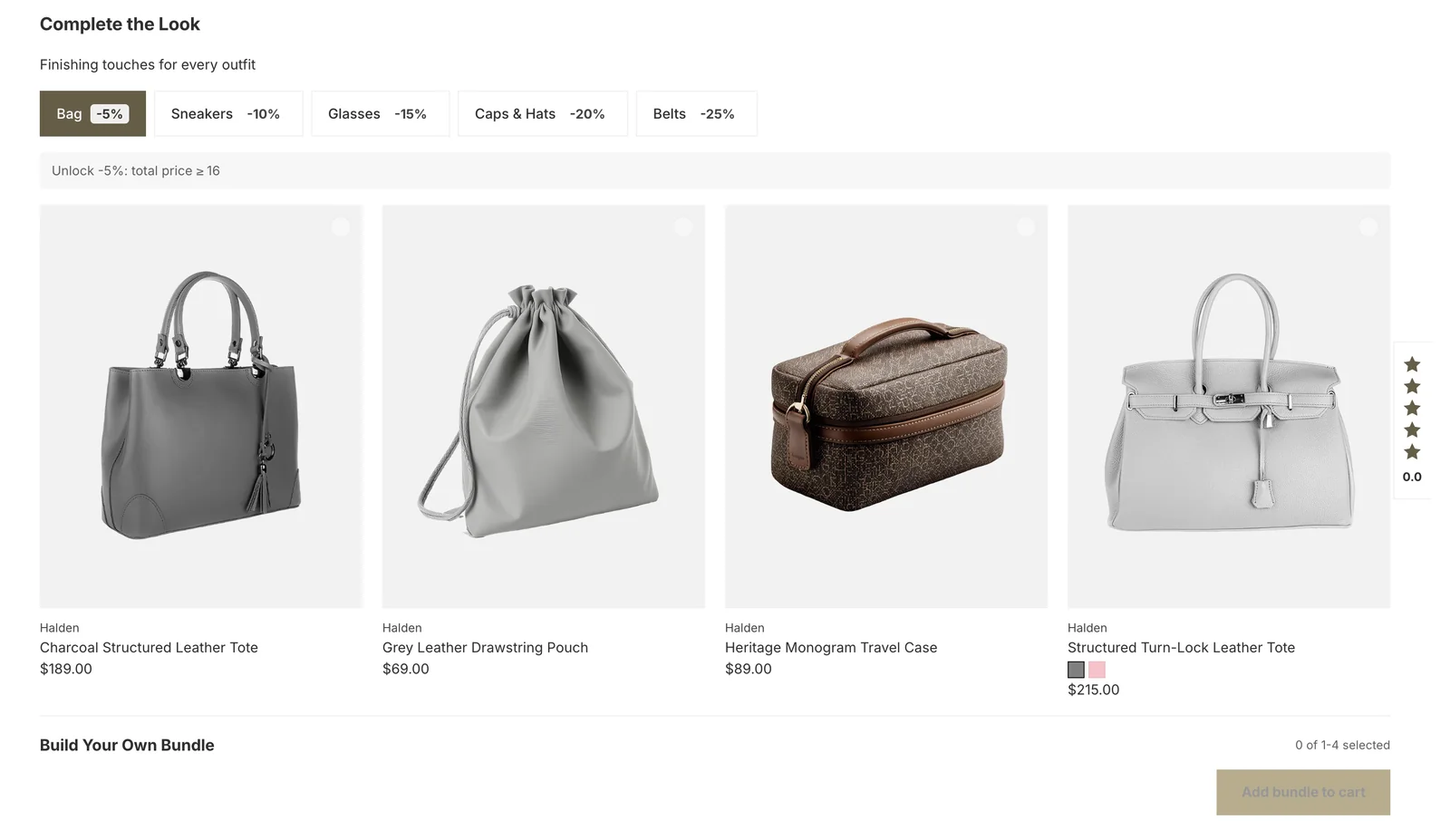
Done. The offer is now live. Below is the example on the storefront — the builder on its listing page, with a discount tier per category and a “0 of 1-4 selected” tray.
Not showing up?
- Status must be Enable, and the relevant surface switched on.
- Check the Bundle Listing Page address is set and unique — without it the bundle has nowhere to live.
- Every product involved must be active and in stock — an unavailable product takes the offer down with it.
- If you set Active dates, confirm today falls inside the window.
- Storefront changes take about a minute to sync.
Related
Last updated on